Growing up in West Virginia, I've seen my share of snow. Some of that snow fell in skiffs that my mother referred to laughingly as "Mother Nature shakin' her feather tick", and others have come down in storms that make the latest February in Morgantown a paradise on Earth. I was actually born in the midst of a December snowstorm, and the windshield wipers on the car were broken - so my father drove 65 miles to the closest hospital, which was Davis Memorial in Elkins. However, one of the most violent snowstorms in my memory occured a few days before Christmas in 1984 - when we still lived on the farm in Germany Valley.
I didn't realize it then - and who does realize much when they're 8? However, the few years we spent on the farm formed a lot of who was to become later. My ties to my family history (my Granny grew up just down the road in a log cabin), my interests in ghosts (the house was haunted by 2), and other aspects of my life came to be during that time.
To my knowledge, there are (sadly) no photos of the farm during the time we lived there. I don't know why - I can only guess that we were too busy livin' to record our lives. However recently we have made several trips back to the old farm, which is now in derelict shape but still recognizable. And even though it is worn and I have grown, there is still a strong familiarity with the place. It still remembers me, and the things I love.
 In the above photo, it doesn't look like much. The house is run down, the gardens are overgrown, the henhouse has collapsed, the road is gone, and the pond has vanished back into the holler. But when we lived there, the house was painted bright white, the roof was silver, and the gardens were always full of plants. The hills held flocks of sheep, a herd of beef cattle, and the occasional mountain lion - one of which was coal black.
The henhouse was full of chickens, geese, turkeys, guineas - and whatever other bird we brought back from the stock sale in Moorefield. On the back of the henhouse was the pigpen, where we had pigs. It's completely gone now. Above the tree to the left, a black willow, we had a dam built and it held back the mountain stream to make a small pond. There the ducks nested with the other waterfowl, sometimes preferring to roost in the black willow than in the henhouse.
 This photo above captures a little of the beauty of the place. There was a giant sycamore to the right of the photo as well. It was torn up in the tornado that also blew down the barn in the north field. You can still see a bit of the fence that once surrounded the yard, which I remember being strewn with flowers my mother had planted, and at the one end was the swingset that took my uncles two days to put together - with several parts left over.
 One of the ghosts, the Purple Lady, as we called her - spent many days watching out the upstairs window to the right. She once held a conversation with my aunt, and she was never terrifying. To the contrary, she was like a member of the family - and I will say you could never ask for a better burglar alarm than a ghost in the house to protect you. Another ghost, Capt. Daugherty (US Civil War Captain- he had a peg leg) would walk the stairs every night and often during the day, depending on his temperament.
 The porchswing hung on the far right side of the porch, and it was there we were sitting when we heard my brother screaming for help. The bull that he had taunted for months had finally cornered him - in the henhouse. The bull didn't try to attack him, but it wouldn't let him leave the building until my father went and shooed the bull away.
 It was in this once grand henhouse that my brother was trapped by the bull. You would not know it to look at it now, but many mornings we gathered eggs by the bucketfuls from this building!
 This is the back porch of the house - and the door led into the kitchen. There was a pump there once, but it never worked even when we lived there. We had water, gravity fed from the spring up on the mountain. When we lived there this porch was a favorite place for our passel of 17 cats, the geneaology of them all we knew clear down from their grandmother Charlotte. Charlotte's daughter, Sylvester, had four daughters - Mouse, Rat, Calico, and Sylvester Jr. They in turn had kittens whose names I've forgotten, but in all there were 17!
 This wide overgrown space is the former garden. The fence line to the left was the upper fence, and there is a lower fence just out of the frame. From one end to the other there was corn, potatoes, rhubarb, tomatoes, beans, and whatever else we could plant. Many days we would have gone hungry if it weren't for the "garden suppers" as Mom called them. It was at one end of this garden, near the kitchen door, that we had a Christmas dinner on the picnic table - it was 73 degrees outside! Of course that was a novelty for us, so we got to rampaging around the yard and too many of us stood on the picnic table and it collapsed.
The hill above the garden is not only a field for the sheep and cows, but there is a small cemetery on the top of the hill. Dad built a fence around it while we lived there, and it is still there today, although you can barely see the stones it surrounds. That is also the hill we went sledding on - using the hood of a truck. There was a guide wire at the bottom of the hill that we all ducked to miss - except my aunt Patsy. When we said "duck!" she stuck her head up and said "what?" and was knocked off the sled, but unharmed.
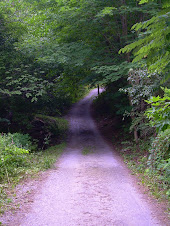
We had a lot of fun on the farm. It was a tough travel in and out, which was a half mile on a dirt road, and was even worse in winter. The worst winter, as I said, was in 84. We walked out, unknowingly, in the middle of a blizzard. About half way out we were nearly frozen, and abandoned the Christmas gifts at the side of the road to make it out on foot to the car parked at the main road. Once we children were all safe in the vehicle, our parents warmed back up - left us in the care of our aunt Tamela, and went back to get the gifts. They found all of them, despite the wind having blown them around except for one. It was later found in the spring lying under a small cedar tree. Late Christmas? I think so.
After that horrifying experience, my father moved us off the farm in the autumn of 85 and up onto the mountain where they live now. It was a good move since it made it easier to get out in winter, but it took us away from the farm, the animals, the gardens - and the ghosts. Or so we thought. In a small way all these things still exist in my world.
I have two cats - Franklin and Julius. My house is full of family mementos - including the horseshoe from over the kitchen door of the farmhouse (I took it on one of my recent trips back as a souvenir). And ghosts? Well, those who know me know there are still ghosts in my life.
Although It's been a great while (has it been 25 years?) since we left the farm, I will never forget it. It helped to make me who I am - and I hope it did a good job.


.jpg)


